MT5 Usage Guide [A must-read for beginners] Thorough comparison of recommended FX brokerages!


Thorough testing is essential to maximize the effectiveness of automated trading tools, especially Expert Advisors (EAs) used with MetaTrader 5 (MT5 ). The testing process consists of three main stages: optimization, back-testing, and forward testing, each of which plays an important role in the potential success of a strategy. Through this process, we can analyze in detail how a trading strategy will perform under real market conditions and make adjustments as needed.
Performance Verification
By properly testing the automated trading tool, you can see specifically how the strategy has performed on historical market data. This allows you to know in advance the expected returns and risks, and to verify the effectiveness of the strategy prior to the actual investment of funds.
Strategy Optimization
During the testing process, the response of the strategy in different market conditions can be observed and several parameters can be adjusted, including entry and exit conditions and risk management techniques. This optimization process allows us to further refine the strategy and find the settings that lead to better trading results.
Responding to unknown market conditions
Not only back-testing based on historical data, but also forward testing can be used to evaluate how expert advisors perform in unknown market conditions, especially in real-time market environments. This ensures that the model is not over-optimized for specific historical conditions and tests the strategy's resistance to more general market conditions.
risk management
Testing will reveal the strategy's potential maximum drawdown and other risk indicators, which can then be used to properly plan fund allocation and risk management strategies. This will help you avoid unexpected large losses and aim for more consistent returns.
EA testing involves the following four steps in order. By going through these steps, the EA will be suitable for the market and your investment policy, and you will be able to operate it with confidence. Although you may be in a hurry to trade and make a profit as soon as possible, it is very risky to start operating your EA for real money without testing. As a result of being in a hurry, it will take a lot of time to recover your funds if you lose control of the EA and incur losses. Let's calm down and proceed with the verification one by one firmly.
The optimization process involves adjusting the parameters of the EA and finding the most effective settings based on historical market data. During this phase, a variety of settings are tried, including entry and exit conditions and money management strategies, to seek the best possible balance between profitability and risk.
Back testing is the process of applying a strategy to historical market data over a specific time period to evaluate its performance. This testing quantifies the potential profitability and risk of the strategy and reveals expected returns and maximum drawdowns. Backtesting is intended to see how well a strategy has responded to past market conditions and is not a guarantee of future performance, but it is one measure of a strategy's relevance.
Forward testing evaluates the actual effectiveness and generalization performance of a strategy by applying the optimized settings to unknown market market data. While this testing is often done in real-time market conditions, it is inefficient to suddenly validate with real delivery rates, so prior validation using "unknown historical data" allows us to observe how the strategy reacts to unknown market conditions.
Finally, the operation is verified using real delivery rates. At this time, the strategy is tested under real market conditions using virtual funds (demo account) to perform a final check before going live. If all tests are successful and we are confident that the strategy can be operated in a real account, we will launch the strategy into the market using real funds.
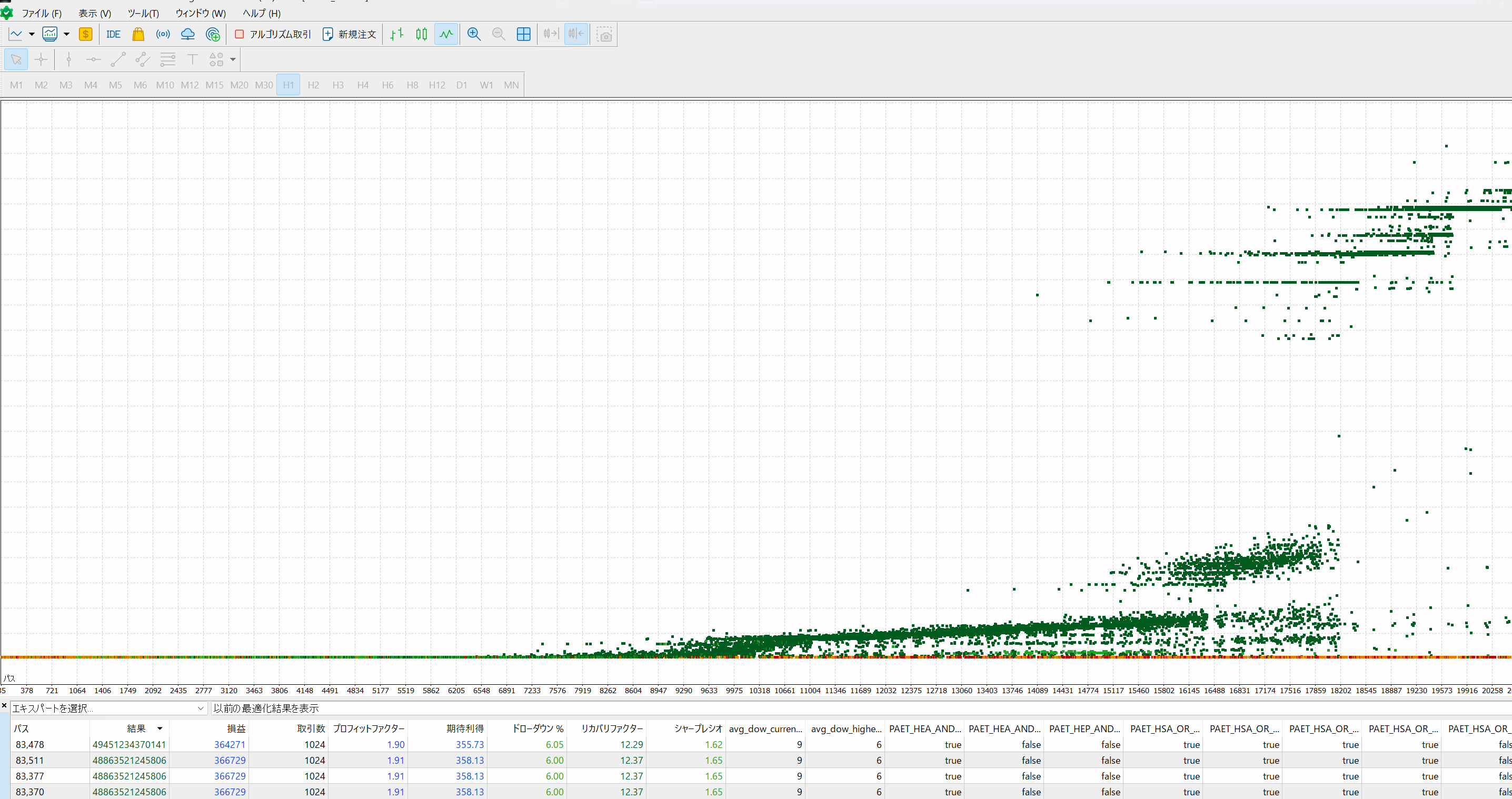
Optimization" is one of the powerful back-testing features offered by MT5's Strategy Tester function.
It is the process of adjusting the EA's parameters and finding the most effective settings based on historical market data. This function systematically tests through a series of possible parameter values and automatically identifies the best combination.
At this stage, the various settings involved in trading, such as the timing of trades and how funds are managed, are scrutinized to achieve the most profitable and risk-controlled strategy.
Time savings
MT5's optimization engine uses genetic algorithms to quickly test a large number of different parameter combinations and efficiently find the optimal settings.
The optimization function can automatically perform a large number of parameter combinations and record the validation results as a score.
This allows for automatic identification of parameter combinations that record superior performance.
Improved Profitability
Through the optimization process, you can select a set of trading strategies that best fit the market and thus improve your overall profitability.
Risk Reduction
Optimization can include risk metrics to identify realistic parameters that balance risk and return, not just profit.
Overlearning Risk
Optimization may result in settings that overfit historical data, which may reduce adaptability to unknown market conditions.
Data quality and scope
The historical data used should be of sufficient duration. At a minimum, at least 10 years of data should be used for optimization.
A sufficiently long test period will help to provide a more comprehensive understanding of the effects of the strategy in different phases of the market (expansion, contraction, crisis) by taking into account changes such as multiple market cycles, seasonal variations, etc.
Optimizations based solely on short-term data or specific market conditions run the risk of over-learning, which increases the likelihood that the parameters used will not work at all in production.
Needs to be verified in detail by back testing.
The results obtained by the optimization function are limited to some indicators such as overall score, total profit/loss, PF, and drawdown.
Backtesting should continue to be performed to determine detailed trade history and detailed test results.
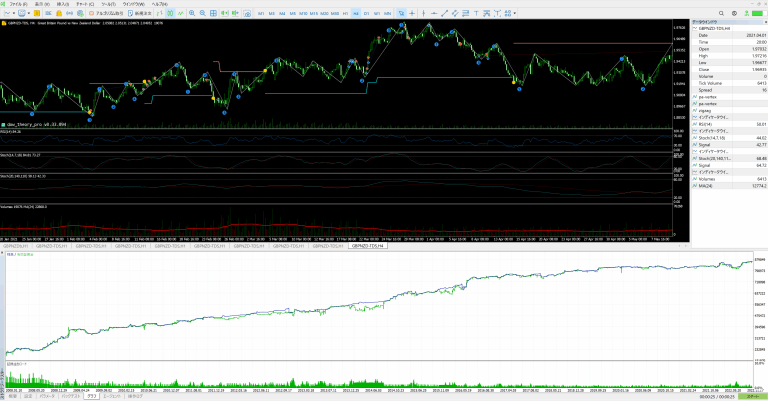
Back-testing is the process of evaluating how effective a strategy has been by applying it to historical market data. This testing quantifies the performance of the strategy over a specific time period and reveals potential profitability and risk.
The goal of optimization is to identify parameters that record good performance, whereas the goal of back-testing is to obtain detailed trade performance on specific parameters.
The quality of the relevant strategy is evaluated in detail by checking the individual trading history and various indicators (drawdown rate, profit factor (PF), recovery factor (RF), sharp ratio, etc.) that measure the performance of the trade.
Using the MT5 Strategy Tester's backtesting feature, you can run backtests on EAs and view detailed reports. This is a very excellent feature and should be fully utilized.

Strategy Effectiveness Assessment
You can get a concrete picture of how well your strategy performs under historical market data and specific parameters.
Understanding the balance between risk and return
Expected returns and indicators such as maximum drawdowns can be evaluated in detail.
By evaluating whether these indicators are consistent with your ideal trading strategy image, you can determine whether your trading strategy is good or bad without putting your real money at risk.
Fine-tuning of trade strategies
By varying the parameters, it is easy to see how the trade results change.
Problems relying on historical market data
Backtesting, like optimization, is merely evaluating the effectiveness against historical data. We need to reconfirm the validity of the training results to see if they work in a real trading environment. This will continue to be evaluated through forward testing.
Ensuring statistical reliability
Increasing the number of trades is critical to statistical validity. It is common to need at least several hundred to several thousand trades of data to evaluate the behavior of a strategy under different market conditions.
Statistically, the larger the sample size, the smaller the standard error in estimating the mean and the more reliable the results. For example, a backtest involving more than 1,000 trades over a period of time can provide a more statistically significant evaluation of a strategy than a test involving 100 trades.
Even a strategy that appears to be theoretically superior will be a theory without sufficient number of trades and past verification. It is advisable to evaluate whether a strategy is effective or not with sufficient historical verification.
Long-term testing:.
The back-testing period, as with optimization, should be at least 10 years or longer. A sufficiently long testing period will help to provide a more comprehensive understanding of the effects of the strategy in different phases of the market (expansion, contraction, crisis) by taking into account changes such as multiple market cycles and seasonal fluctuations.
Forward testing is a test that aims to evaluate the presence or absence of generalization performance by validating it using unknown data against the optimization training period (=in-sample period).
It is an important process to verify if the parameters trained by optimization will still be valid for different periods of time.
This ensures that the trade results in the optimization period are not coincidental.
Forward testing does not necessarily require the use of future data.
Verification using historical data not included in the in-sample period (= out-of-sample period) is also forward testing.
Since verification with real rates is time-consuming, back-testing with historical data that is out-of-sample period in advance (i.e., forward testing against unknown data) allows for more efficient verification.
Check for generalization performance
If the data are over-fitted to the in-sample period data, the forward and back-test results will diverge significantly.
We know in advance that such strategies and parameters are risky to use in production.
Speeds up verification and makes it easier to iterate
Testing with out-of-sample period data in advance allows for early confirmation of generalization performance.
Validation at real rates is very time consuming. Completing validation cycles quickly not only helps to achieve early monetization, but also to validate a wide range of strategies in a shorter amount of time and find better strategies.
Temporal independence (separation of in-sample and out-of-sample data periods)
In-sample data (= data used for optimization) and out-of-sample data (data used for forward testing) should be split to avoid temporal overlap.
For example, if data from 2010 to 2020 is used as the in-sample, data from 2021 onward will be used as the out-of-sample.
This allows us to verify if the training results (=optimization parameters) have generalization performance for unknown data.
Ensure adequate forward testing period
Extremely short forward test periods make it difficult to evaluate generalization performance. Depending on the trading frequency of the strategy, it is recommended that at least one year be available as out-of-sample data.
For this purpose, the historical data to be prepared should be as long as possible, and then decide which period to divide between the data used for optimization and the period used for forward testing (historical data).
Test with historical data and trading conditions as assumed in production
Trade costs, such as historical data spreads and trading commissions, have a significant impact on trading results.
The reliability of the validation results is improved by validating with settings that are close to the trading conditions that are assumed to be used in a real account.
MT5 can automatically obtain historical data tied to the brokerage/account type currently logged in and use it as test data.
Before testing, make sure you are logged in with the brokerage/account type you expect to operate.
In addition, detailed settings such as trading commissions can be adjusted from the Strategy Tester function, so that verification should be performed by preparing conditions that simulate the real market.
Forward Testing (Real Rate (Demo Account)) is the process of testing a trading strategy using real market data, but with a demo account (virtual money) instead of real money.
Since the brokerage demo account offers rates that are very close to those of the real account, it is possible to verify the rates on the assumption that the account is operated in the real market.
By using a demo account, you can test the effectiveness of your strategies without risking real money and confirm that there are no glitches or unintended behaviors in the operation of automated trading, so that you can operate in a real account with confidence.
Elimination of risk
No real money is used, so strategies can be tested without financial risk.
Identification of gaps between theoretical and real-world results
Real-time market data can be used to assess the impact of factors that are often overlooked during back-testing (slippage, execution rejection, etc.). This information can help you identify weaknesses in your strategy and develop a more realistic risk management approach.
Rehearsal for the show
Activating and verifying the EA in a demo account is a very important step in terms of reviewing the procedures for running the EA in a real account.
By actually launching the EA and running it for an extended period of time, it can serve as a rehearsal for running the EA in production.
Note the account type for demo accounts.
Brokerage firms generally offer multiple account types, with different spreads, trading commissions, and other conditions depending on the account type.
Check to see if there is a demo account that has the same conditions as the account type of the real account you plan to operate, and open a demo account with the same account type as your real account.
This makes the conditions of the demo account and the real account very close to each other, so that verification can be performed with the real account in mind.
Need to set up a VPS or other trading environment
Highly available and reliable servers are required for the long-term, uninterrupted operation of automated trading systems.
To do so, prepare a server environment that can operate stably over a long period of time, such as a virtual private server (VPS), and use that environment for forward testing.
Check to see if all operations can be carried out without problems, including access to the VPS, deployment of EA, and confirmation of application operation before and after maintenance.
The optimization and forward testing (real rate (demo account)) confirmed that it matched our trading rules, maintained a good balance between profitability and risk, and had a certain level of generalization performance.
This should clearly put you in a position to operate in a real account with more confidence than if you had not conducted the test.
If there are operational concerns even after that, we recommend that you start with a low-risk operation by adjusting your money management methods, such as smaller deposits and smaller lot sizes, and gradually increase the size of your transactions.
The entire process of optimization, back testing, forward testing (historical data), and forward testing (real rate/demo account) must be performed.
In addition, it is necessary not only to implement the strategy once, but also to modify the strategy and start over from optimization if issues are found in each testing process, and to repeat this process many times, dozens of times, to improve the quality of the strategy.
Basically, we will still perform optimization, back testing, forward testing (historical data), and forward testing (demo account),
In some cases, the best parameters based on the results of optimization are released with default values, and optimization may be omitted.
In this case, you should perform the three steps of back testing, forward testing (historical data), and forward testing (demo account) by yourself to confirm the results.
This guide details the importance of the testing process and specific procedures for automated trading tools used in MetaTrader 5 (MT5). Proper testing allows you to maximize the effectiveness of your trading strategies and to know in advance how they will perform under real market conditions. The key steps listed here are.
These tests are essential to avoid unexpected losses and pursue stable profits. When using automated trading tools, be prepared to trade with confidence by conducting sufficient testing in advance.