
MT5 Indicator : Automatic detection of 14 patterns!


We have developed an MT5 indicator that applies the Dow Theory approach. (I spent several months developing one indicator...)
We are pleased to introduce you to the actual use of the system, which has dramatically simplified market analysis and strategy formulation, which used to be time-consuming, and enabled us to make quick transaction decisions.

Dow Theory is an analytical method created by Charles Dow in the late 19th century. He was the founder of stock indices and proposed Dow Theory as a new approach to understanding market movements. The theory revolutionized market analysis at the time and continues to be referenced in a wide range of financial markets to this day.
Central to Dow Theory is the idea that market trends are shaped by certain principles. The key principles are as follows
Market prices reflect all known information - economic, political, psychological, and all other factors. This represents the idea that prices are always determined based on the most current information in the market.
According to Dow Theory, market trends are classified into three types (long-term, medium-term, and short-term). Long-term trends (primary trends) represent major market developments, medium-term trends (secondary trends) represent corrections or reactions to long-term trends, and short-term trends (minor trends) represent daily market fluctuations.
Each trend has three phases. The accumulation phase is when well-informed investors enter the market, the participation phase is when the public enters the market and prices begin to move, and the distribution phase is when prices peak and early investors lock in profits.
When analyzing market trends, different market indicators and averages need to confirm each other. The reliability of a trend is enhanced when several indicators, not just one, show similar movements.
The strength or reliability of a trend is also confirmed by volume. If prices rise when volume increases, the trend is considered strong and vice versa.
The trend is expected to continue until a clear turning signal appears. This suggests the importance of following the existing trend until a change is identified regarding market movements.
In the FX market, the Dow Theory principle of "the market incorporates all information" applies directly because exchange rate movements are strongly influenced by international economic and political events. In addition, due to the nature of the forex market, it is particularly important to identify short- to long-term trends. For example, long-term trend analysis allows one to understand underlying economic direction and policy changes and to develop trading strategies based on this understanding.
The Dow Theory's concept of medium-term and short-term trends also correlates with volatility in the FX market. For example, the release of important economic indicators or political events can affect medium-term trends. Short-term trends are often influenced by daily news and market sentiment.
Applying Dow Theory to Forex trading allows you to understand market movements and build powerful strategies for making lucrative trades. We will introduce you to specific approaches in trading strategies based on Dow Theory and a home-made indicator that anyone can easily replicate.
Identifying trend turning points is very important in a Dow Theory-based trading strategy. Turning points are locations where the direction of the trend may change, and by identifying them, you can change positions early to secure profits or minimize losses. To identify turning points, closely analyze market highs and lows and other technical indicators.
A trend-following strategy is a method of taking a position in line with the major trend indicated by the market. The key to this strategy is to identify a trend on a given basis and invest in its direction. For example, if the long-term trend is upward, the trader would consider taking a buy position. Conversely, if the trend is downward, a sell position is advantageous.
By identifying trend turning points based on the Dow Theory, it is possible to determine uptrend intervals and downtrend intervals on a certain basis. This narrows down the direction in which entry is considered advantageous, and by taking other conditions into account when making trades, the winning rate can be increased.
The fact that the trend turns at the push-low and return-high lines, which are the trend turning points of the Dow Theory,
We can think of it as.
Push lows and return highs will be rounded up/down in stages as the trend continues. This allows for smaller losses by adjusting the stop-loss line to more favorable conditions based on the evidence.
We have developed a custom indicator for market environment recognition and entry point identification based on several ideas of Dow Theory.
Trend turning points and the trend direction in the current bar can be seen at a glance.

The term "push low" refers to the most recent low rate during an uptrend segment.
At the timing when the break of the highest recent price is confirmed, the previous low is used as the push low.
In a market that is gradually making higher highs, the push-lows will also cut higher.
When the push low is below the bar, the uptrend is considered to be over and the downtrend has entered.

The "return high" refers to the most recent high rate during a downtrend section.
At the timing when the most recent low break is confirmed, the previous high is used as the return high.
In a market that cuts the lows in stages, the return highs also cut back.
When the high is exceeded by the bar entity, the downtrend is considered to be over and the uptrend has entered.

To identify specific entry points within trend following, it is useful to evaluate the waveform and continuity of the trend.
The word "wave" generally reminds us of Elliott Waves, but in this case
is considered to indicate the continuation of a trend, we have incorporated our own judgment process to identify the wave.
In addition to simply detecting waves, we also performed an automatic count of waves to assess their continuity and entry dominance.
This will make it easier to determine whether the idea of "3 or 5 waves are likely to grow, but if it continues to 7 or 9 waves, it is likely to stall" is valid or not.
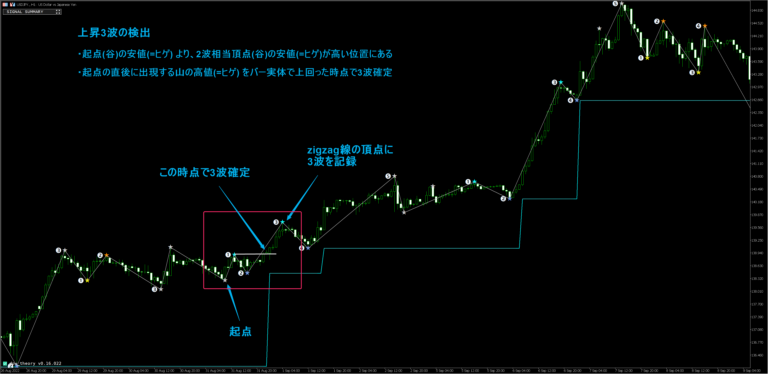
Displays a buy or sell signal when a trend change or a specific wave count is detected.

Signal win/loss decision
When a signal is generated, a fictitious stop-loss rate and profit rate are assigned to the signal, and the profit/loss calculation is performed using whichever rate is reached first, with a positive profit indicating a win and a negative profit indicating a loss.
The stop-loss rate fluctuates over time, so even if you reach the stop-loss rate, you win if your profit is positive.
<Example>
Signal Direction: Buy
Signal rate: 150.000
Stop loss rate : 149.500
If the stop-loss range = 150.000 - 149.500 = 0.500
If the risk-reward ratio is 0.8,
150.000 + <Stop-loss price range: 0.500 > x 0.8 = 150.400 is the profit rate.
Automatically calculates a hypothetical profit when trading a specified number of lots based on buy/sell signals and profit/loss conditions.
For example, it is possible to determine in an instant whether or not it is advantageous to enter the USDJPY at the time of the third wave detection on the 1-hour time frame.
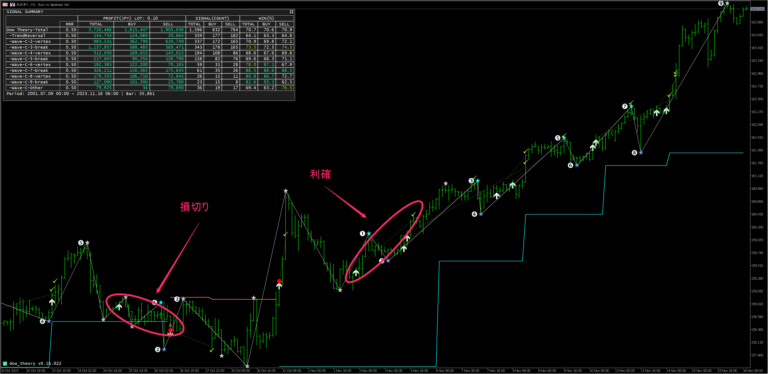

Custom indicators have so many advantages that we encourage you to consider utilizing them.
To improve the accuracy of technical analysis, it is essential to evaluate multiple indicators in combination with each other in a comprehensive manner.
We are expanding our lineup of originally developed indicators on this site so that they can be used immediately,
Please also refer to the other indicator introduction articles.


This indicator is
Aiming for 100% annual interest! Automated Trading Tool Helios
is distributed free of charge to those who use the automated trading tool "Helios" in their real accounts.
https://smart-trading-strategy.com/selene-dow-theory-based-swing-trading-ea/?lang=en
We will provide you with an indicator and a set of support documents when you contact us through our service desk.
*Indicator-only use is available for a fee. Please contact the service desk for details.
The secret to successful FX investing with MT5 is to combine it with an international brokerage firm.
❌ Few MT5-compliant vendors exist.
❌ There is a risk of additional margin. May incur losses in excess of the amount deposited.
✅ Many brokerages offer a zero-cut system that allows you to risk no more than the amount of your deposit.
✅ Major foreign brokerages such as HFM and XM are safe to use.
If you use MT5, please consider opening an account at an overseas brokerage firm.
To achieve efficient investment,
structuring and automation
is essential.
We will continue to compile ideas to help you analyze the market environment and provide you with tools that you can use immediately.
Automated trading tools make it possible to automate trades, but the decision of when to start and stop the EA is a personal decision.
In order to use the EA wisely, we hope you will make use of the indicator to help you analyze the market environment.


